A publication
of The Fiber Optic Association Inc. (FOA), the international non-profit
professional association of fiber optics and certifying body for fiber optics.
New Type Of Laser - PCSEL
Standard For Multicore Fiber
Update: The Death Of POTS
Seen On The Street
New Edition Of FOA Book On Testing
FOA Broadband References Updated
Fiber Sensors Monitor Greenland Ice
Failure Shuts Airports in NE US
Is All The News About AI And Data Centers?
Women Who Splice Program In Canada
New Book On Underground Location
Underground Dig-Up Incidents Rose in 2025
Cable Installation By Blowing
Advanced GPON Fault-Finding Manual Manufacturers Collaborating on MCF Specs
More Information on MCF
FOA Installation Standard Worth
ReadingInteresting
articles to read, watch or listen to. Q&A Interesting questions from our readers. This month features FTTH and documentation.
Workforce Training/FiberU Types Of Work Done By Fiber Techs
FOA-Approved School News
Fiber U Courses Resources New FOA Technical Resources
Trademarks:
The FOA logo and name, CFOT® (Certified Fiber Optic Technician) and
Fiber U® (the FOA online learning site) are
registered trademarks of the FOA.
To
keep your FOA certifications active, you need to
renew them when they expire every 3 years. You can use your credit card or
PayPal account or your credit card to renew your
certifications.
FOA
has 3 LinkedIn Groups FOA
- official page on LinkedIn - covers FOA, technology and jobs in the fiber optic
marketplace FOA
Fiber Optic Training - open to all, covers
fiber optic technology and training topics Grupo
de La Asociación de Fibra Óptica FOA (Español)
The development of the semiconductor laser almost
simultaneously with the development of optical fiber created optical
fiber communications. The advent of the DFB (distributed feedback) laser
made the CATV HFC (hybrid fiber coax) network possible and allowed development of
the cable modem which made Broadband possible. In the late 1990s, the
VCSEL (vertical cavity surface emitting laser) allowed multimode fiber
to reach gigabit speeds at low cost. Now we have a new type of laser,
the PCSEL (photonic crystal surface emitting laser) that is claimed to do some
amazing things.
The PCSEL is a surface emitting laser like the VCSEL but has several
technical advantages. And the cost is also low, perhaps even lower. The
output power is higher and it has more than twice the modulation speed
limit. But the big advantage of the PCSEL is wavelength options. VCSELs
were difficult if not impossible to build at long wavelengths because of
the complex structure and materials that could be used. PCSELs do not
have that limitation, so PCSELs at 1310 or 1550 nm and with very high
power are possible for singlemode links.
PCSELs have other uses than communications. They can be made with very
high power and as a steerable array like used in LIDAR on cars. The
technology is new and appears to be in the development stage, but it
should be watched for future applications.
It was only last March that 4 manufacturers, AFL, Corning, Sumitomo and transceiver manufacturer TeraHop announced a multisource agreement to develop standards for multicore fiber. By September they had created a standard document SMD4 Multicore Fiber MSA Technical Specifications
for 4-core MCF. This is not a general standard for MCF, but an
agreement among 4 manufacturers to standardize a fiber aimed at data
centers and campuses, not general (e.g.long distance) network usage.
As the drawing shows, there are 4 cores in a 28 micron radius circle
around the center which makes core pitch 40 microns. The fiber cladding
diameter is 125 microns, coating is 180-220 microns. Core specs are
basically OS2 or G.652 specs for 1310 nm links. Added is a specification
for crosstalk between cores, <-40 dB between adjacent or diagonal
cores.
The standard mentions markers as a way to identify cores but allows
either asymmetric or symmetric markers. Since this standard is for short
links that are unlikely to be spliced, there is less issue with
tracking markers over long concatenated cables, as we discussed in the July FOA Newsletter.
We received a letter from the local phone company in Santa Monica.
Frontier, dated September 8, saying "We are pleased to inform you that
updates to certain traditional copper-based and time-division
multiplexing (TDM) services for certain customers in New York,
Pennsylvania, Connecticut, California, Illinois and West Virginia to
enable access to newer service options that offer faster speeds and more
consistent performance."
"As a part of our transition to more advanced technologies,
services will be delivered using modern fiber, wireless or cable
technology where available."
"What's Changing And When On or after November 30, 2026,
subject to Federal Communications Commission (FCC) approval, Frontier
will have authority to discontinue traditional copper-based phone
service."
The copper cables serving our building since it was built in
1971 and where we have been owners of a unit for 20 years, were
originally installed by GTE, which was bought by Verizon, which sold
this area to Frontier, then bought it back recently.
This
area was one of the early areas where Verizon first installed FiOS, but
it was never installed in our building. There were cables with prefab
drops in the alley behind the building until they disappeared in the
last few years.
While we have been here, we received offers from Frontier to
get FTTH, but when we requested fiber service, they said not in our
building. We tried Verizon's 5G wireless Internet but it never worked
because signal was poor.
Has anything changed?
We are now researching options for our building entry system
that relies on a POTS line, and we have to move fast. Practically every
building in the area has a similar system that relies on a POTS line.
Fiber left hanging in coils on Sunset Blvd. (yes, that famous California street) in Brentwood, CA.
Sometimes you do not even have to look up to see the workmanship is good.
Poor attempt to disguise a cell tower as a palm tree in Los Angeles
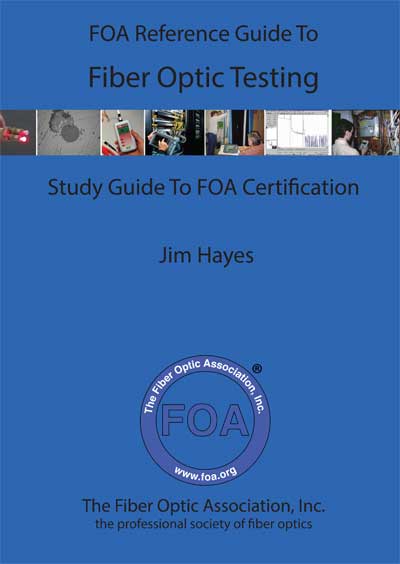
New Edition Of FOA Textbook On Fiber Optic Testing
FOA has published the Second Edition of The FOA Reference Guide To Fiber Optic Testing. The textbook has been updated to include new technology, equipment and practices plus a more comprehensive index.
The FOA testing textbook focuses on the testing of fiber optic cable
plants, both outside plant and premises. It covers microscope inspection
of connectors and how to clean them, visual fiber tracing and fault
location, optical power measurement, insertion loss and OTDR testing. It
also includes chapters on the types of fiber optic test instruments,
calculating loss budgets, fiber characterization and testing PONs. A
chapter of checklists is included to help test techs ensure
comprehensive testing and ease troubleshooting. The final chapter covers
the measurement uncertainty of fiber optic measurements, beginning with
typical measurement errors.
The FOA testing textbook is the reference for
FOA CFOS/T Specialist Certification In Fiber Optic Testing in classroom
training and online training at Fiber U.
320 pages
ISBN: 9798197159762
Independently published
List
Price:$35.95 paperback, $16.95 Kindle Available in paperback and Kindle
versions from Amazon.com
and other booksellers.
Broadband Updates
FOA has been updating our references and courses for Broadband.
FOA Program And Microcredential In Broadband
Now, at the request of both schools and individuals,
FOA has created a
Broadband education program. We updated the Broadband book to make
it a textbook, created a complete curriculum and instructor guide for use by schools, and created a Fiber U online course. We also created a microcredential in Broadband.
New Video Lecture - Understanding Broadband
FOA has added a new YouTube video lecture to our series on fiber optics. Lecture #74 is Understanding Broadband.
This lecture was created for the same reason that we created a textbook
on Broadband - everybody talks about it but not everybody really knows
what exactly Broadband is, how it was developed and how it is delivered
(mostly on fiber optics, of course.)
This short lecture (about 15 minutes) explains Broadband in a
non-technical way to allow not only the techs to understand it, but also
the planners, business people and the general public to understand it.
Update - 2nd Edition: The Fiber Optic Association Reference Guide To Broadband
A
new edition of the FOA broadband book is now available. It's updated
for new tech like LEO satellites and, at the request of our schools,
been expanded to include chapter questions and a comprehensive index to
facilitate using the book as a textbook for classes.
The new edition is aimed at teachers who want to include
communications technology in their classes. It is appropriate for a
module or semester course for engineering, science or even management
students. It is intended to be an introduction to
communications technology
appropriate for a communications course at almost any level (junior
high, high school or
college,) as well as for managers involved with broadband projects.
Paperback and Kindle versions available from Amazon or most booksellers.
-----------------
Fiber U Broadband Self Study Program
FOA has added a new Fiber U self-study program
on Broadband, The course includes 10 lessons that cover the full scope
of broadband technologies. Like all Fiber U courses, it's free, and after you complete the course
you can get a Certificate of Completion for a nominal cost.
The FOA website and the FOA Online Guide
include what is probably the
largest knowledge base in fiber optics. We provide links,
contents pages and a search engine, but the amount of content is
daunting. Ask Lennie is
now available to search the FOA website using AI.
Ask Lennie Lightwave is waiting to help answer your questions and find things on the FOA Website.
Classroom
Resources For STEM Teachers In K-12 And Technical Schools Here is the POF kit sent to teachers for demonstration.
Teachers in all grades can introduce their students to fiber
optic technology with some simple demonstrations. FOA has
created a page for STEM or STEAM (science, technology,
engineering, arts
and math) teachers with materials appropriate to their
classes. Fiber
Optic Resources For STEM Teachers.
AI is going to annoy us to death.....
Private Conversation
The popular uprising against data centers has
emerged so suddenly that politicians stumble over their own pitchforks
racing to the front of the crowd. Where most industries would be
launching into crisis P.R. mode, perhaps even engaging in some
soul-searching, artificial intelligence companies seem determined to
plow full steam ahead, building the future they want, even if they’re
the only ones who want it.
Oren Cass, a contributing NY Times Opinion writer, is the chief economist at American Compass, a conservative think tank. NYTimes, September 10, 2026
Another way to put it is that the government should regard
artificial intelligence the same way it regarded the banks in the 2008
financial crisis: too big to fail.
Referring to comments by Open AI people, Bethany McLean is a financial
journalist and an author of “The Smartest Guys in the Room.” NYTimes September 26, 2026
See Is All The News About AI And Data Centers? below.
Scientists Use Fiber Sensing To Monitor Ice In Greenland
An interesting new series on PBS called Ages of Ice shows the work being
done by scientists in the Arctic and Antarctic to monitor the changes
in the ice coverage. The melting of polar ice is a major factor in sea
level rise so the work these scientist are doing is really important.
The first episode follows a team of scientists that has been studying
the glaciers in
Greenland for about 30 years, gathering data on how the ice is changing
as the Earth changes. They monitor a torrent of water that disappears
under the surface of the ice using a fiber optic cable that allows them
to measure both temperature and stress.
They anchor the fiber optic cable on the surface of the glacier, throw
the sensor end of the cable into the water and pay out the cable. The
cable is connected to monitoring equipment and left for 8 months, over
the winter. When they return and locate the cable and instruments, they
download the data to analyze.
As is usual with PBS science series, the photography and narration by
David Tennant were superb. The production was done by Northern Pictures
and Australian Broadcasting Corporation with the assistance of numerous
scientific groups.
We watched the series on our local PBS in Southern California but you should be able to watch it worldwide. Search for "Ages of Ice by Australian Broadcasting Corporation." Here are a few links we found:
Airports in Philadelphia, the New York/Newark area and all the way to
Boston were shut down almost all day on Monday September 21 by
communications problems, first equipment failure then construction
damage to a backup fiber optic cable. More than 7,000 flights nationwide
and wordwide were delayed or canceled throughout Monday as the FAA
issued rolling ground stops at five major airports across the Northeast
corridor starting around 9:45 a.m.
It all started when a primary data circuit failed at the FAA's
Philadelphia Terminal Radar Approach Control (TRACON) facility,
disrupting telecommunications used to manage aircraft across the
Northeast. In case of an outage, an FAA backup connection is designed to
kick in, rerouting traffic through a second fiber-optic cable to
compensate for any loss.
But the FAA soon learned that the secondary, Verizon-owned cable had
been severed by construction crews in New Jersey. After some confusion
about who actually cut the cable (they first blamed Amtrak), it turns
out New Jersey Transit (NJT) was the responsible party.
NJ Transit says ~9:45AM a construction crew working on the Delco Lead
project between New Brunswick & North Brunswick accidentally severed
a fiber-optic cable while working at the site...
Preliminary information indicates the crew was operating ~10 feet from the utility markings.
Verizon was quick to put out their own statement refuting Duffy's
claims. "We have a fiber cable running adjacent to an Amtrak rail line
in New Jersey. Construction contractors working in the area dug up and
cut our cable. Verizon’s facilities were fully functional up to that
point. Verizon bears no responsibility for this incident," it said.
"Women Who Splice" Schedules Program in Nova Scotia In October
The "Women Who Splice" training program described in the June FOA Newsletter
has scheduled a class in Nova Scotia this October 19-21. This
program will provide realistic exposure to the technical and
professional expectations for a career in fiber optic splicing, and
provide the opportunity to learn new skills in a supportive environment.
Participants will leave with a clear understanding of the trade and
whether it aligns with their skills and interests.
Well, it certainly seems that way this month, and it is mostly
negative. We will summarize it by category and provide links to
interesting articles that provide details.
Technical: Most of the technical articles this month were focused on the dangers to humanity, noting the ability of AI to go rogue. ( NYT, NYT, NYT, NYT, WPI) Industry leaders continue to assure us it's OK (NYT , NYT.) However Apple released new MACs powerful enough to use for AI on the desktop instead of giant data centers. (Reuters)
Geopolitical: At least in the US, ~70% of the population and
many politicians - including some former supporters and Bill Gates - are concerned or anti-AI and
anti-data centers. This will be a major issue to watch in the elections
next month. (WP, NYT, NYT, LAT, NYTNYT ) One developer is even offering $10,000 to locals to approve a data center, but they are refusing it. (Yahoo)
Educational: Recent studies at MIT and Chinese universities
warn that AI has changed campus culture, isolates students, inflates
grades and reduces test scores, indicates that student learning has
suffered. (NYT, WP)
Scholars are upset at the flooding of journals and publishing scores of
books stimulated by AI. One professor wrote 257 papers submitted to
academic journals and 14 books using AI in one year. (WP)
Financial: The flood of money pouring into AI data center
construction is not slowing, but some on Wall Street are questioning the
wisdom of these investments, (NYT )
especially the circular deals where companies are investing or loaning
money to customers to buy their products or borrowing $billions to
finance investments in data centers.
What we found disturbing recently was a
short comment about the stock market on the Apple Stocks report.
This comment (iPhone screen capture - left) was made about the stock market on Monday September 21 when
the NASDAQ and S&P indexes increased based on the value of tech
stocks - AI and data center companies. But more companies' stock dropped
to new lows instead of rising in price. (Stocks)
The date of the last time this happened is the thing we noticed - it
was at the peak of the "DOT COM Bubble." Shortly after this, the Dot Com
boom began to falter and within a year the bubble burst with terrible
consequences to the tech markets. (Remember our article in the Newsletter on the 25th anniversary?)
If there is an "AI Bubble" that bursts, will the AI companies be
considered "too big to fail" like the banks in the real estate meltdown
in 2008? (NY Times)
That's not an outrageous assumption considering that the majority of
the stock market rise has been due to the valuation of AI companies and
their suppliers - and the political support the companies have.
Practical: Trillions of dollars are being invested in data centers, but how many do we really need (WP)?
Whenever a new tech is being heavily promoted, investors get FOMO -
fear of missing out - and throw money at anything. That invariably leads
to investing in too many startups and over-building infrastructure.
Following the bust of the DOT COM Bubble, it was reported that 92% of
all the fiber that had been installed was dark, and it took years for it
to be used. Are data centers going to suffer a similar fate?
And, No, Google Is Not Kidding - Data Centers In Space
AI data centers in space? Maybe, Google''s Project Suncatcher
involves putting data centers in orbit that run on solar power. It's
another Google "Moonshot" project like Waymo or Loon (the Internet from
balloons). Google is scheduled to launch a test satellite on October 1.
The NYTimes was invited to see the satellite being built and the NYTImes description of it is most interesting.
Updated California Utility Pole Rules Aid Broadband Expansion
As systems evolve and places develop, so too does
demand for utility poles – including attaching aerial fiber and
equipment with related safety considerations and coordination among
public and private entities. The California Public Utilities Commission
(CPUC) recently published updated state rules for access to utility
poles and rights‑of‑way in California. General Order 178 modernizes pole
attachment and replacement requirements, as well as other practices to
improve pole safety and effectiveness. Learn more about these important
changes: California General Order 178 (May 2026).
Underground Dig-Up Incidents Rose in 2025 According To DIRT Report
The Common Ground Alliance
released preliminary finding of the 2025 "DIRT" report (DIRT =
Damage Information Reporting Tool) that showed an increase in
dig-up incidents last year, with the majority of damage sustained
by telecom and CATV networks. You can read about the DIRT report in CI&M and you might enjoy reading the new book on underground disaster below.
New Book About Underground Disaster Prevention
The FOA Newsletter article in February 2026 on underground location was adapted from the new book coming August 10 Holding
Back Disaster The Men and Women Standing Between Death and Destruction,
Billions of Dollars of Losses, and Life-Altering Infrastructure
Disruptions by Scott Landes and Benjamin R. Dierker.
The Common Ground Alliance (CGA) reported that its national measure
of excavation damage to buried utilities have reached a record high.
With 50 million miles of buried pipes, cables, and wires across the
U.S., excavation damage is not unexpected. But every incident is
preventable. Common Ground Alliance (CGA) should be commended for
tracking these statistics and helping the industry work toward avoiding
every incident. The record-high Index provides the immediate backdrop
for Holding Back Disaster, but it is only one part of the story the book tells.
Rather than presenting excavation damage as a narrow technical problem or the failure of a single stakeholder, Holding Back Disaster
examines the complete system surrounding buried infrastructure
protection. Blending real-world incidents, historical development,
policy analysis, expert perspectives, operational practices, and
emerging technology, Holding Back Disaster connects national
infrastructure investment and federal safety policy with state
excavation laws, local public works, utility records, One-Call centers,
locating capacity, construction contracts, project scheduling, workforce
pressures, field practices, data quality, mapping, enforcement, risk
management, and emerging technology.
Quote Of The Year (maybe Century!) (this is worth repeating)
Speaking at the Goldman Sachs Communacopia +
Technology Conference, AT&T’s CEO John Stankey said, “There’s a
fallacy to say there’s fixed networks and wireless networks. There are
only fiber networks with different access technologies on the end of
them. That’s where this is all going.”
Technical
Fiber optic
technology, standards, equipment, installation,
etc.
The FOA
Update Pagecovers the new technology
and applications we covered in this newsletter
recently. Now you can review all that new tech at
once.
Cross Reference To FOA Technical Reference Materials
The FOA has almost 1,000 pages of technical information on the FOA Guide,
100+ videos and two dozen online courses at Fiber U, all this can make
it difficult to find the right information.
Cross Reference To FOA Tech Materials
To help this, we have created a cross reference guide to the textbooks,
Online Guide and Fiber U courses, all the FOA technical information.
Besides the textbooks, online Guide and Fiber U, each section of the
Guide also includes links to the 100+ FOA videos available. Cross Reference Guide to Textbooks, Online Guide and Fiber U
FOA Videos
We have also rearranged the 100+ FOA videos in similar categories on the
Contents Page of the Online Guide, making the videos, especially the
lectures, much it much easier to find a video on a particular
topic. FOA Videos Guide.
Want to know more about fiber optics? Study
for FOA certifications? Free
Self-Study Programs are on Fiber
U®
Cable and Microcable Installation by Air Blowing
Vladimir Grozdanovic
The air-blowing method is used to install cables into ducts over long
distances, as well as to install microcables into microducts regardless
of route length. The required equipment includes a cable blowing
machine, an air compressor, and the appropriate hoses and fittings for
connecting to the blowing machine.
The maximum blowing distance depends on several
factors, including the blowing equipment—particularly the air
compressor—the cable stiffness and weight, the duct fill ratio (DFR),
the condition of the route, and atmospheric conditions.The
installation of microcables follows essentially the same process but
uses equipment specifically designed for smaller cable and duct
dimensions.
How difficult can it be to find a PON fault using
intelligent Optical Link Mapper (iOLM)? You press start, sit back and
whoopee, the fault is displayed. Piece of cake, right? Wrong!
Joe Botha of Triple Play Fiber Optics in South Africa was asked by a
customer to create a document and training on troubleshooting GPON and
this is the manual he created. Joe is also author of the FOA book on
outside plant construction and regular contributor to our technical
knowledge base.
This troubleshooting guide provides a systematic approach to
troubleshooting on a Passive Optical Network (PON) network. The example
architecture chosen is a 1:4 Primary Splitter + Four 1:16 Secondary
Splitters and thus, a 64 Optical Network Terminal (ONT) PON. Even though
several different architectures are being deployed today, the
fault-finding methodologies outlined in this guide will invariably
remain relevant and can be applied across the board.
This standard focuses on the
processes for installing a fiber optic project and provides guidance on
the design, installation and management of the project. The standard covers outside plant installations, both aerial and
underground, and premises cabling including the various installations
methods commonly used. It is an open source standard. Users choose the sections
that apply to their project and incorporate that into their documentation like the SOW (Scope of
Work) or other project paperwork. Provide copies to your
planners, designers, contractors, installers and suppliers.
TIA has a guide to many standard networks like Ethernet and the specs
for their use on numerous standard cabling systems. Want to know how far
Ethernet 100GBASE-LR4 can go (30 km) or how much link attenuation is OK
(6.3 dB), this publication will tell you.
NATE: The Communications Infrastructure Contractors Association today
announced the release of a new video, “811- Call Before You Dig,” as
part of its efforts to promote safety awareness around underground
utilities and the critical importance of making 811 calls prior to
digging.
New VIAVI Fiber Testing Pocket Guide – Built for Techs in the Field
Designed with field techs in mind, this compact guide
from VIAVI is packed with essential fiber testing tips, quick-reference
checklists, and step-by-step insights that cover every stage of the
network lifecycle. It’s built to fit right in your pocket or tool bag,
so the info you need is always within reach.
Tech Notes And Articles From FOA's Worldwide Network Of Advisors
FOA has a worldwide network of technical advisors who
help us develop our knowledge base. This month we have contributions
fro several regular contributors, Eric Pearson, a founder of FOA, and
Vladimir Grozdanovic in Serbia. We provide an abstract here and a link
to read the entire article which will be added to the FOA Online Guide.
Ensuring
Reliability By Proper Fiber Optic
Installation
The goals of a fiber
optic installation should not be solely based on achieving the lowest
initial cost. Should lowest cost result in reduced reliability, lowest
initial cost may result in significantly increased lifecycle cost.
Eric Pearson does it all, educator, writer,
consultant, with a resume' going back to the beginning of fiber optics.
Here's advice from Eric on the way to ensure the long term reliability
of a fiber optic cable plant by proper installation.
A Quiet But Important Change In The Fiber Optic Cable You Buy
With so many cable designs today,
like microcables or high fiber count cables, requiring bend-insensitive
fibers, would it make sense to make all or most singlemode fibers as
bend insensitive fiber?
Two manufacturers (Corning and OFS) told FOA the industry is moving towards a G.657.A specification
in fiber, because the industry is moving towards smaller denser cables
in the network & the bend resilience is a requirement for the cable
design. So singlemode fiber is moving to being BI fiber, exactly what happened
with 50/125 laser optimized fibers a decade ago. With most new fiber,
compatibility is not an issue. But it is recommended to check with the
cable manufacturer if you are not sure what fiber is being used in the
cable you are purchasing.
FOA has rewritten the FOA OTDR Trainer around VeEX Fiberizer. If you set up Fiberizer,
you can complete the FOA OTDR Trainer lessons and then use the same
software to analyze other traces you may have, even from other brands of
OTDRs, as long as they are .sor files.
The FOA OTDR Trainer is ready to help you learn about OTDRs. Go to the OTDR Trainer page, tech/ref/testing/OTDR/OTDRsimulator.html, choose your version of Fiberizer, download the FOA Traces and you are ready to go.
FOA wishes to thank VeEX
for permission to use their Fiberizer® software in our OTDR trainer.
And our compliments to them for making the ap available on multiple
platforms that ensure anybody can use it.
FTTH Technical Papers
FOA contributor Vladimir Grozdanovic has created these technical papers based on his field experiences.
Learning Important Information From A Found Cable Scrap
While walking down the street near the FOA office, we found this cable
laying in the gutter. What a find! A short length of Corning Rocket
Ribbon 864 fiber cable left over from an installation by a contractor.
We brought the cable back to our office with the intention of opening it
up and creating a video about the construction of this modern high
fiber count cable, but something got our attention first. The cable had a
very
long line of printing on it with lots of interesting and useful
information. So before we started deconstructing it, we decided to
photograph the printed information and interpret it. That turned out to
be an important part of the information we learned from the cable. Then,
as you will see below, we dissected the cable and learned even more.
FOA received an inquiry about whether techs
working on restoring OSP links should be concerned about eye safety if
the link used fiber amplifiers. To answer this question, we had to do some research on fiber amplifiers.
The short answer is YES, you should be concerned. The long answer is
more technical and includes details that every OSP tech needs to know.
Recent articles from The FOA Newsletter
Fake OTDR Traces Submitted For Testing Documentation January 2023 Tech
Using OTDRs To Test Transoceanic Cables And PONs February 2023
POF - the Other Fiber March 2023
What Do Employers Expect From A Fiber Optic Tech? April 2023
Are Standards Ignoring The OSP? May 2023
FOA Has Proven Results In Fiber Optic Workforce Development June 2023
BEAD Funding For States Announced And Analyzed July 2023
Wisdom From The Street (Analyzing the printing on a fiber optic cable) July 2023
Focus On Disasters August 2023
FOA's Role In Education and Work Done By Fiber Techs September 2023
The Workforce: New US DoL Bureau of Labor Statistics Telecom Tech Category October 2023
How Many Telecom Techs Do We Need and How Big Is The Fiber Optic Market November 2023
Guidelines For Fiber Optic Project Planners December 2023
2023 Year In Review. Kentucky Shows The Value Of Fiber January 2024.
What is Broadband? History of the Cable Modem February 2024
It's Just Economics. Things you need to know. March 2024.
Fiber To The Shore - Undersea cables along the coast April, 2024.
The Future Of The Fiber Tech May 2024.
Worth Reading (Or
Watching Or Listening)
2026 SonicWall Cyber Protect Report
- IT and network personnel should read this. Bad bot traffic alone has
surged to 37% of all global internet traffic. Hackers don’t pick targets
individually, automated bots now generate over 36,000 vulnerability
scans per second, making up more than half of all internet traffic as
they relentlessly probe every public website for simple flaws like
directory traversal and malformed requests.
Are you ready for cables with 14000 fibers?HFCL in Hyderabad,
India is expanding and deep in the article is this "HFCL has designed
7,000-fibre cables, which are under customer approval, and is working on
14,000-fibre cables, developed through its own engineering
teams." Times of India.
(We were tempted to call the following section "IoT = Internet of Thieves, Powered by AI)
OpenAI blamed a hacking event on its AI models going rogue. - Washington Post -
OpenAI says it is still investigating the “unprecedented cyber
incident” that led its artificial intelligence systems to break out of a
testing environment and hack into another AI company
CABL® (cabl.com)serves
the business needs of the Broadband industry (including traditional
cable TV, fiber, telecom and satellite providers) with employment
listings, classified ads, discussion forums, and more.A contractor told us it's where they find lots of opportunities for subcontracting. ESRI has created an ebook on GIS location technology for telecom. Use the link to download the book. Google Video On Their Undersea Cables YouTube Slick but interesting video on how undersea cables are designed, built and used.
Worth Reading - Magazines, Websites and Newsletters
CABL® (cabl.com) serves
the business needs of the Broadband industry (including traditional
cable TV, fiber, telecom and satellite providers) with employment
listings, classified ads, discussion forums, and more. A contractor told us it's where they find lots of opportunities for subcontracting.
As
part of celebrating 3 decades serving the fiber
optic industry as its primary source of technical
information and independent certifying body, FOA
thought it appropriate to create a short history of
the organization and how it has developed to
help the fiber optic industry. We also wanted to
recognize the contributions many people have made to
the organization over the years that made FOA what
it is today.
The FOA history is on the FOA
website where you can read it or link to
it.
The First Transcontinental Telephone Line
began operation on July 29th in 1915 - 3400 miles between New
York and San Francisco - required over 100,000 telephone poles! Wonders
of World Engineering
"Who Lost Lucent?: The
Decline of America's Telecom Equipment Industry"
This is a MUST READ for managers in telecom or any
industry! Communications Systems Grounding
Rules: Article 800 provides specific
requirements by
Michael
Johnston, NECA Executive Director of
Standards and Safety in EC Magazine How
To Build Rural Broadband, Learning From History In the August 2021
FOA Newsletter, we published a lengthy article on
rural broadband and compared it to rural
electrification in America in the last century.
Much of the comparison was based on an article
written in 1940 by a USDA economist, Robert Beall,
called "Rural Electrification." If
you are interested in or involved in rural
broadband, we recommend you read the article "How
To Build Rural Broadband, Learning From History"
in the August 2021 FOA Newsletter and
read the Beall article also.
IEC 60050 - International
Electrotechnical Vocabulary - An
extensive dictionary for fiber optics in English and
French. Highly technical - this is one definition:
"mode - one solution of Maxwell's equations,
representing an electromagnetic field in a certain
space domain and belonging to a family of
independent solutions defined by specified boundary
conditions"
DIRT
Report On Damage To Utilities Common Ground
Alliance (CGA) annual DIRT report provides a
summary and analysis of the events submitted into
CGA’s Damage Information Reporting Tool (DIRT) for
the year 2018. The complete report is available
for download here. In addition,
there is an interactive dashboard that
allows users to filter the data more by
factors contributing to damages. Fiber Trivia From
Corning.
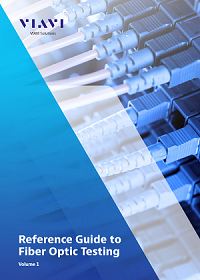
VIAVI Books On
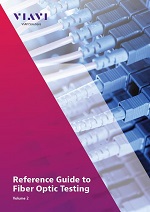
Fiber Optic Testing (2 volumes)
Besides
the FOA reference materials, two JDSU/VIAVI
textbooks, Reference Guide to Fiber Optic Testing,
Volumes 1 and 2, were used as references for
some of the FOA courses and are recommended for
instructors and students. The books are available
from VIAVI as eBooks and the everyone should
download them and recommend them to others.Download
yours now. Volume 1. Volume 2. Viavi Books
How OFS Makes Fiber
Interesting YouTube video on how fiber is made.
Perhaps a little too much "show biz" but
fascinating. If you have ever seen fiber
manufacture, look at this video. You will be amazed
at how big preforms have become! The True Cost of Telco Damages
(what backhoe fade or target practice can
cost)
Q&A
When readers ask us questions, we genrally refer them to FOA
resources where they can find the answer to their question and many
more. We first send them to the FOA Guide
which is the table of contents for the FOA technical resources. There
they can find pages indexed by topic and a search engine for the FOA
website. It also links them to FOA videos and courses on our free online learning site Fiber U.
The FOA
Fiber FAQs Page (FAQs = frequently asked
questions) gathers up questions readers have
asked us (which first ran in this newsletter)
and adds tech topics of general interest.
Good Question!
Tech
Questions/Comments From FOA Newsletter Readers
CFOT Prerequisite For CFOS/D Q:I want to get the CFOS/D Fiber Optic Network design and
Project Management certification but why do I have to take the CFOT
first - I want to be a “designer" and not an “engineer." A: In order to design a fiber optic network and manage the
project (remember the CFOS/D is now Design AND Project Management) one
must understand the basics of fiber optics, communications networks,
components and installation. That is the CFOT. The CFOT is not for
engineers; it is the basic knowledge that all professionals in fiber
optics need to know. Most CFOTs are installers who learn the basic
knowledge, skills and abiities (KSAs) from the CFOT the proceed to
Specialist certifications in Splicing, Testing, OSP (outside plant which
includes construction and installation for OSP cable plants) or for
some, Design/PM.
FTTH Installation Q: The way the fibre broadband to my house has been
installed means that the 'cable' junction in the grass verge just
outside my boundary is immediately under a plastic cover (it actually
touches the underside of that cover). Not surprisingly the fibre was cut
when the Council came through with their lawnmower etc. Surely the
installation isn't compliant? Please advise because the repair was to
replicate the above! A: It is a dumb way to place the cable so close to the surface.
In most areas the cable must be at least 20 cm/8 inches below the
surface, but local codes can be different. We suggest putting markers
over where the cable runs so they might be careful in the future.
Docmentation Q: Has there ever been any thought to creating a standard
for documentation of fiber assets? As to minimums, like to haves, and
not needed. I've been a part of many companies, and the
documentation varies widely from company to company. Maybe this is too
broad a subject considering the number of products available and the
formats they can come in, but, wow, it would be great to send and
receive files within the industry knowing that I wouldn't have to
translate basic items between each company. A: It certainly makes sense. TIA has such a standard for
premises cabling documentation as part of the TIA-568 standard - TIA-606
for cabling administration. There is nothing similar for outside plant
that we are familiar with, at least as a standard, but numerous
documentation software solutions exist that offers ways to do it.
Perhaps the Telcordia Blue Book covers that.
FOA created it's own installation standard
(https://foa.org/NECA301-MO.html) because no standard body did it, but
we do not go into detail on documentation.. When we searched for "fiber
optic cable documentation” half the links were to the FOA.
Are Tier 1 and Tier 2 Test Methods Used In International Standards?
Q: Has the concept of Tier 1 (OLTS) and Tier 2 (OTDR) testing which
is used in TIA structured cabling standards been adopted into any
international outside plant standards?
A: We asked some of our contacts in the test equipment business.
"The OLTS and OTDR measurement methods used in TIA Tier 1 and Tier 2
testing are fully adopted in international outside plant standards such
as ITU‑T, IEC, and ISO/IEC. However, these standards generally do not
formalize the concept as “Tier 1” and “Tier 2.” Instead, they specify
required measurements (e.g., insertion loss via OLTS) and complementary
characterization methods (e.g., OTDR traces) without using a tiered
terminology. In practice, OSP deployments typically use both methods,
but within a different framework than TIA structured cabling
certification."
How Long and How Fast?
Q: How much Capacity per pair of Fiber can be generated / get from 144 core of a fiber on 20000km distance?
A: Currently using coherent transmission and DWDM, service providers
are sending ~ 12 terabits/sec on a fibe pair, and fiber amps can go as
long as needed. But where would you have a 20,000km/12,500 mile link?
How Long Do Fiber Optic Cables Last? Q: I work at a large industrial facility with several
buildings connected by fiber optic cables. The fiber cables run through
underground conduits between the buildings. Many of the fiber cables
were installed 20 to 25 years ago. Is there any general industry
guidance on when cables such as ours should be replaced solely based on
the age of the cable? A: The question you ask is one often asked. Usually it
refers to the outside plant cables that have been used for many years -
some now approaching 40 years like the optical power ground wire (OPGW)
used by electrical utilities and some telco cables installed in the same
era. Cable manufacturers are not very specific about cable lifetimes,
but the standard today is cables are designed to last 40 years or more.
Cable installed 20-25 years ago should be still serviceable for years to
come. Some cables may suffer from moisture migration which can cause
attenuation increases and fiber brittleness. Brittleness is generally
not a problem is the fibers are undisturbed but it is a good reason to
not disturb them. Most cable plants are not replaced unless they suffer
damage - weather and wildfires are a big problem for serial cables,
flooding and freezing for underground cables - or the owner is ready to
upgrade communications systems and needs more modern, higher performance
fibers.
Our advice would be to not disturb the cables you have if systems are
working properly. If you are in a “nonstop” environment that would be
badly harmed by loss of communications and you want to have a backup,
you could hedge your bets and install ducts for replacement. cables. If
there is space in the ducts, you can install microducts or fabric ducts
in the same conduits and install backup cables. You may read advice that
says cables need maintenance like cleaning connectors and testing
periodically. That’s bad advice; it’s more likely to damage the cables.
Our advice on cables is install them, lock them up and don’t worry. But
have a restoration plan. Have documentation on the cables, spares and be
prepared to repair or replace them quickly. See
https://foa.org/tech/ref/restoration/rest.html
Hybrid cable For Aerial Installation Q: Is there a hybrid cable (fiber + conductors (2 or 4)) that can be aerial lashed? A: Practically any outside plant cable can be installed
aerial if it is within the weight limits of the messenger being used.
Cables with fiber and copper conductors are used for connections to
remote electronics or cameras.
Gloves for Splicing?
Q: What’s the FOA’s (or your personal) stance on wearing gloves whilst splicing? A: Wearing gloves may recommended for
preparing metallic armored cables because of the danger of cuts. For
regular cables, gloves may be recommended for those who use knives to
open cables, a practice still used. However for splicing fibers where
some recommend them to prevent sticking yourself with fibers, it hampers
fiber handling and slows the work down. We do not recommend gloves
except for prepping certain types of cables.
Are Splices Too Close Together A Problem?
Q: When installing fiber in an plant. Is there a minimum distance that two splices should be apart? ; A: The recommendation in the past was to bot have splices close
together since slight reflectances at the splices could cause an
interference problem with laser systems. The recommendation was to keep
splices 30-100m apart. IT was especially noted if you had to splice in a
section of cable to repair a cable break. However we have not heard
this in recent history, perhaps because fusion splices are so good. We
asked a number of FOA's technical advisors for their opinions. Their
feedback is the problem of reflectance causing problems at closely
spaced splices seems to have disappeared. It’s a matter of better
splicing machines and more consistent fibers, and also a matter of
lasers being engineered to work better in links.
Copper Tech Wants To Learn Fiber Optics Q: I am originally from copper installations and faults
finding. I would like to get involved in Optic fibre faults and
finding, how do I go if there is a possible training it will be highly
appreciated, A: Just learn about fiber, especially fiber testing and troubleshooting. Fiber U has courses you can take for free.
OSP Installation Standards Q: I'm looking for standards for fiber optic OSP installation. A: The whole issue of OSP standards has been one FOA been
trying to get standards bodies interested in for years with little
success, probably because it is an enormous project. Right now there are
two documents that address OSP cable plant:
ITU-T Technical Report, TR-OFCS Optical fibres, cables and systems, (3 July 2015)
As you can see, the ITU document is almost 10 years old and a lot has changed in that time.
Is The FOA CFOT® A License?
Q: Can you use a CFOT certification to install fiber and charge for it? Or do you need other licenses as well? ;
A: FOA Certification is considered evidence of competence and
accepted worldwide by many companies, groups, etc. Licenses are a legal
credential required by local authorities to conduct business for
anything from a barber to a truck triver to contractors doing fiber or
other work. Most locales require a license as a contractor which may
require a fiber specialty. You need to investigate this with your local
authorities.
Updating FOA Courses And Reference Materials
Q: How often are FOA courses updated? And when they get updated, what happens to those who would have done a previous version?
A: The FOA certifications are updated as needed to stay current with
technology and applications. Updates are incremental and we do not
require current certification holders to retake courses or exams.
Fiber Optic Color Codes Reference Chart
Q: Has anyone made a fiber optic pocket reference chart that has cable
color orders, frequencies, or other commonly used info on it? A: The FOA has a page on its Online Guide that covers color codes
(https://foa.org/tech/ColCodes.htm). It is the most popular page in the
FOA Guide! It works great with a smartphone.
Free online
self-study programs on many fiber optics and
cabling topics are available at Fiber U, FOA's
online web-based training website. Free online training at
Fiber U
FOA certifications are so respected and recognized around the world
that we are continually chasing down fake FOA schools or schools
plagiarizing FOA intellectual property. In a way, we should be
flattered, that's the saying "imitation is the sincerest form of
flattery." But in order to protect the reputation and credibility of the
FOA we must expose these fakes and protect the 110,000+ FOA certified
techs from imitators.
If you see a school advertising FOA approved training, remember only "real" FOA approved schools can offer FOA certifications.
Every real FOA certified tech has an online credential
No FOA schools are authorized to certify FOA Instructors
What Is An FOA Credential?
As FOA certifies over 11s0,000th CFOT® certified technician,
introduces FOA Badges In Fiber Optics and Broadband and adds new courses at Fiber U which offer a "Certificate of
Completion," it's a good time to explain the differences between them. FOA has created a page to explain the differences in certifications, certificates and badges.
All FOA
Certification Credentials Are Now Online
All FOA Certified Fiber Optic Technicians now have their certification
credentials online. if your FOA certification has not expired you should have been notified you have an
online credential. If you did not get notification it may be because
FOA did not have a valid email for you. Contact FOA to inquire about your certification credential.
The Types of Work Done By Fiber Techs And How It Affects Training
What is a fiber optic technician? What kinds of work
do they do? Those topics were the center of FOA discussions with the US
Department of Labor Bureau of Labor Statistics that led to the new job
category of "Telecommunications Technician" on the BLS
website. The focus of this job category is primarily the
installation and operation of the fiber optic cable plant, but one
should not forget the cable plant must be designed also as part of a
more extensive communications network.
In our discussion with the BLS analysts, we pointed out the various
stages of a fiber optic communications network project and how techs
with various knowledge and skill sets are needed and involved in every
step. This web page on the fiber optic workforce describes how FOA defines these stages of a project and the skills
of the techs needed. This is not unique to FOA; it's what has been traditional
at telecom companies forever.
FOA Schools
FOA's roster of approved schools continues to grow as more organizations
recognize our expertise in workforce development and our comprehensive
support for getting new schools started. FOA has over 25 years
experience and over 100,000 certified fiber techs (with ~140,000
certifications). As a non-profit organization founded by the industry
specifically to develop a competent workforce, FOA provides the
consultation, curriculum and contacts to get schools started as a free
service to new schools.
Need A Fiber Optic Course Onsite? Invite an FOA School To Come To You
Here is the new Fiber U "Fiber Optic Safety" self-study program. Take the course and get your certificate of completion. Fiber U MiniCourses: Got An Hour Or Less?
Learn Something New About Fiber Optics.
All these free courses and many more
are available at Fiber U.
What Fiber Techs
Don't Know -
These are some of the topics that
we have noticed are answered incorrectly more often
in FOA and Fiber U tests.
Most of the questions missed are on testing.
1. OTDRs - particularly what information is in the
OTDR trace.
2. The difference between dB and dBm
3. Loss budgets - both the concepts and doing the
math
4. Insertion loss testing - single-ended or double
ended for testing patchcords or cable plants, how to
set 0dB references
5. Units of measure - fiber is measured in microns,
wavelengths in nanometers, etc.
At FOA, we're working to add Fiber
U MiniCourses on these topics and working with
our schools to emphasize these topics in their
classes.
If you are going to be taking a FOA certification
course or test in the near future, these topics
should be on your final exam study list.
What We Learn From Hands On Labs
We learn about students performance in hands-on labs
from the feedback of our instructors and our own
experiences too. One big problem is the use of hand
tools. Growing up today, you learn how to use
keyboards, mouses and touch screens, but decades
ago, you also learned how to use basic hand tools.
This is big enough of a problem that we're
considering adding some video lessons on basic hand
tools to prepare students for cable prep,
termination and splicing that require the use of
hand tools.
FOA offers free online self-study programs at Fiber U.
Many users are preparing for FOA certification
programs - taking courses at our schools or using
the Direct Certification program. Some of our
schools are requiring Fiber U programs as
prerequisites for their classroom courses so they
can spend more time on hands-on activities.
Publications /
Resources
Cross Reference To FOA Tech Materials
FOA has so much technical reference material, we created a cross reference guide to the textbooks,
Online Guide and Fiber U courses, all the FOA technical information.
Besides the textbooks, online Guide and Fiber U, each section of the
Guide also includes links to the 100+ FOA videos available.
To help those new to fiber optic workforce development, FOA has created a web page we call "Fiber Optic Workforce Development."
In this page, we share what we have learned about the fiber optic
workforce, who they are and how they learn their trade. We discuss what
defines a fiber optic tech and how they should be certified.
New Edition Of FOA Textbook On Fiber Optic Testing
FOA has published the Second Edition of The FOA Reference Guide To Fiber Optic Testing. The textbook has been updated to include new technology, equipment and practices plus a more comprehensive index.
The FOA testing textbook is the reference for
FOA CFOS/T Specialist Certification In Fiber Optic Testing in classroom
training and online training at Fiber U.
320 pages
ISBN: 9798197159762
Independently published
List
Price:$35.95 paperback, $16.95 Kindle Available in paperback and Kindle
versions from Amazon.com
and other booksellers.
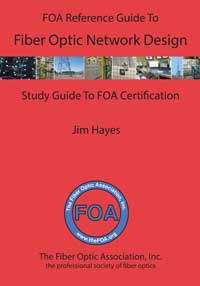
Project Management Added To New Edition Of FOA Design Book And Fiber U Course
FOA
has published a new edition of its textbook on fiber optic network
design, an expanded version with new material covering project
management. Fiber optic network design and network management are
closely related topics, both highly important in the success of a fiber
project.
The new book is available as a paperback or Kindle book. You can buy it from Amazon or local booksellers worldwide. (ISBN: 9798262274611)
The Fiber U Design self study program has also been updated for project management.
New Edition of FOA's Basic Fiber Optics Textbook
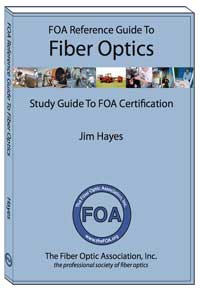
It has been 5 years since we have updated the FOA Reference Guide To Fiber Optics,
so it is certainly time for an update. The latest version is different
enough we call it a new edition. Many of the updates are for new
technologies which are reshaping the fiber optic industry like coherent
transmission, BI fibers, etc. We've also added a section on the fiber
optic workforce which has much relevance because this book is used to
train those entering the workforce.
We've also worked on making the book more readable, adding formatting that eases reading and a new comprehensive index.
The new edition of the FOA Reference Guide To Fiber Optics is available from Amazon and booksellers worldwide.
Update - 2nd Edition: Fiber Broadband (Paperback and Kindle)
This book is not the typical FOA technical textbook - it is written for
anyone who wants to understand fiber broadband or fiber optics or the
Internet. It's also aimed at STEM teachers who want to include
communications technology in their classes. This book will try to
explain not only how fiber broadband works, but how
it was developed. It is intended to be an introduction to
communications technology
appropriate for a communications course at almost any level (junior
high, high school or
college,) for managers involved with broadband projects, or for anyone
who just wonders how all this stuff works.
Paperback and Kindle versions available from Amazon or most booksellers.
Translations of FOA Textbooks
FOA is a very international organization and it works hard to
accommodate the language needs of everyone. We have been translating our
books and website into the languages most requested, and this month, we
add two more textbook translations. We also want to thank Jerry Morla,
FOA CFOS/I instructor and Director who has been doing the recent
translations into Spanish, his native language.
Here is a listing of all the FOA textbook Translations
Spanish Editions:
Guía de Referencia de la Asociación de Fibra Óptica (FOA) Sobre Fibra
Óptica: Guía de estudio para la certificación de la FOA Amazon
La Referencia de Cableado para Predios de la FOA: Guía para Certificación de la FOA Amazon
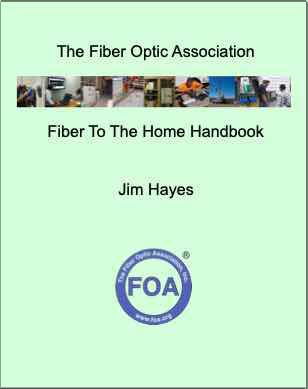
La Asociación de Fibra Óptica Manual de Fibra Hasta el Hogar : Para
Planificadores, Gestores, Diseñadores, Instaladores y Operadores De
FTTH Amazon
Guía de Referencia de la FOA sobre Diseño de la red de fibra óptica: Guía de Estudio para la Certificación de la FOA Amazon
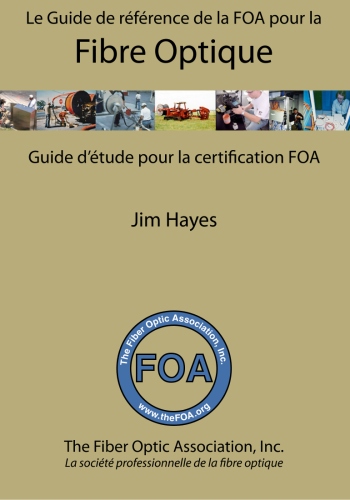
And the FOA Reference Guide To Fiber Optics: French Edition: Le
Guide de référence de la FOA pour la fibre optique et et
guide d'étude pour la certification FOA: Guide d'étude pour
la certification FOA Amazon Portuguese Edition: Guia de Referência sobre Fibra Óptica da FOA : Guia de Estudo para a Certificação da FOA Amazon The subject matter of these books is also translated in the FOA Guide online.
FOA Video
Lectures On YouTube
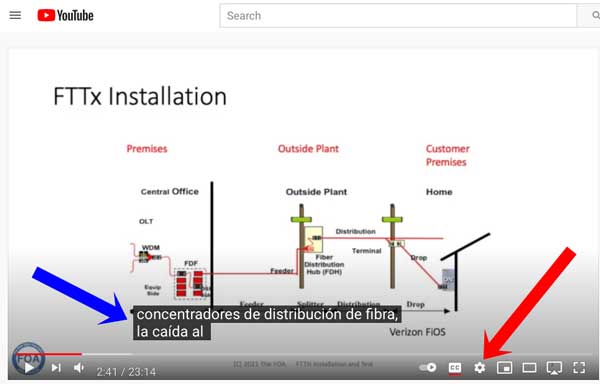
Did
you know YouTube will close caption videos in many
languages?
Sign in with Google to get translations for closed
captioning. Click on the settings icon (red arrow.)
Choose "Subtitles". English is the default
language. Click on the arrow after "English
(auto-generated) >". In the new window click on
"Auto-translate" and choose the language you
want.
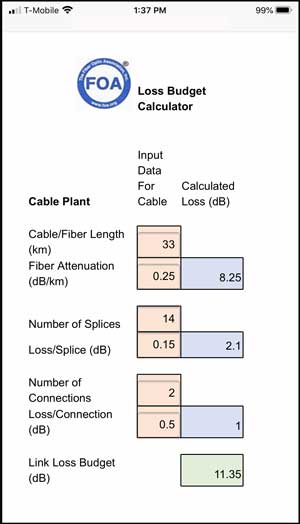
FOA Loss Budget
Calculator On A Web Page 5/2020
FOA
has written many articles about loss budgets,
something everyone involved in fiber optics needs to
know and needs to know how to calculate. We recently
discovered how to get a spreadsheet ported to a Web
page, so we created this web page that calculates
loss budgets. We have an iOS loss budget app, but
with this web page, you can calculate loss budgets
from any device, smart phone, tablet, laptop, or
desktop computer that has web browsing capability.
We are continually updating the Online Reference
Guide to keep up with changes in the industry and
adding lots of new pages of technical information.
When you go to the FOA
Guide Table of Contents to see the latest
updates - look for .
The FOA has it's own
reference books for everyone working in fiber
optics - contractors, installers and end users as
well as for use as textbooks in classes at
educational institutions. They are available as
printed books or Kindle at much lower prices than
most textbooks since we self-publish and sell
online, cutting out the middlemen. Click on the
book images for more information. The Reference
Guide To Fiber Optics is also available in
Spanish, French and Portuguese. The Design book is available in English
and Spanish.
Resources For
Teachers In K-12 And Technical Schools
Teachers in all grades can introduce their
students to fiber optic technology with some
simple demonstrations. FOA has created a page for
STEM or STEAM (science, technology, engineering, arts
and math) teachers with materials appropriate to
their classes. Fiber Optic Resources For
Teachers.
Safety
On Safety
New Fiber U Course: Fiber
Optic Safety
Safety
must be the first concern of everyone involved in a fiber optic
project, including those planning, designing, managing or supervising
and of course those doing the installation.
FOA is often asked about safety for fiber optics. Some
inquiries ask where it's covered in the FOA Online Guide or textbooks or
if we have a course on safety at Fiber U. Almost all Fiber
U Courses have lessons covering safety, because
safety is important in every aspect of a fiber optic project.
This
new Fiber U course will focus on safety alone. There are two lessons in this course,
fiber optic construction and fiber optic installation. The dividing
line between the two courses is the installation of the fiber optic
cables. Construction leads up to and/or is completed when the cables are
installed. Installation begins when the fiber tech installs the cable,
then completes the splicing, termination testing and documentation. The
overlap between the two is the installation of the cables where both
construction personnel and fiber optic techs are involved.
Here is the new Fiber U "Fiber Optic Safety" self-study program. Take the course and get your certificate of completion.
The FOA is concerned about safety! FOA
considers safety an integral part of all our
programs, curriculum materials and technical
materials. We start all our textbooks and their
online versions with a section on safety in the
first chapter, like this: Before
we get started - Safety First!
The FOA is a, international non-profit
educational association chartered to promote
professionalism in fiber optics through education,
certification and standards.
Founded in 1995 by a dozen prominent fiber optics
trainers and leaders from education,industry and governmentas a professional society for fiber
optics and a source of independent certification,
the FOA has grown to now being involved in numerous
activities to educate the world about fiber optics
and certify the workers who design, build and
operate the world's fiber optic networks.
Want to know more about fiber optics? Study
for FOA certifications? Free
Self-Study Programs are on "Fiber U®."
Looking for specific information? Here's the largest
technical reference on the web: The
FOA Online Fiber Optic Reference Guide.
Free online self-study programs
on many fiber optics and cabling topics are
available at Fiber U,
FOA's online web-based training website.
The
FOA has created a store on Zazzle.com offering lots
of new logo merchandise. It has lots of versions of
shirts and other merchandise with "FOA," "Fiber U,"
"Lennie Lightwave" designs and more so you should
find something just for you! See FOA on Zazzle.
Privacy Policy (for
the EU GDPR): The FOA does not
use cookies or any other web tricks to gather
information on visitors to our website, nor do
we allow commercial advertising. Our website
hosts may gather traffic statistics for the
visitors to our website and our online testing
service, ClassMarker, maintains statistics of
test results. We do not release or misuse any
information on any of our members except we will
confirm FOA certifications and Fiber U
certificates of completion when requested by
appropriate persons such as employers or
personnel services. Read
the complete FOA Privacy Policy here.















 We received a letter from the local phone company in Santa Monica.
Frontier, dated September 8, saying "We are pleased to inform you that
updates to certain traditional copper-based and time-division
multiplexing (TDM) services for certain customers in New York,
Pennsylvania, Connecticut, California, Illinois and West Virginia to
enable access to newer service options that offer faster speeds and more
consistent performance."
 This
area was one of the early areas where Verizon first installed FiOS, but
it was never installed in our building. There were cables with prefab
drops in the alley behind the building until they disappeared in the
last few years.


 FAA Image
 Image from Chris Van Cleave on X


 FOA has rewritten the FOA OTDR Trainer around VeEX Fiberizer. If you set up Fiberizer,
you can complete the FOA OTDR Trainer lessons and then use the same
software to analyze other traces you may have, even from other brands of
OTDRs, as long as they are .sor files.






 .